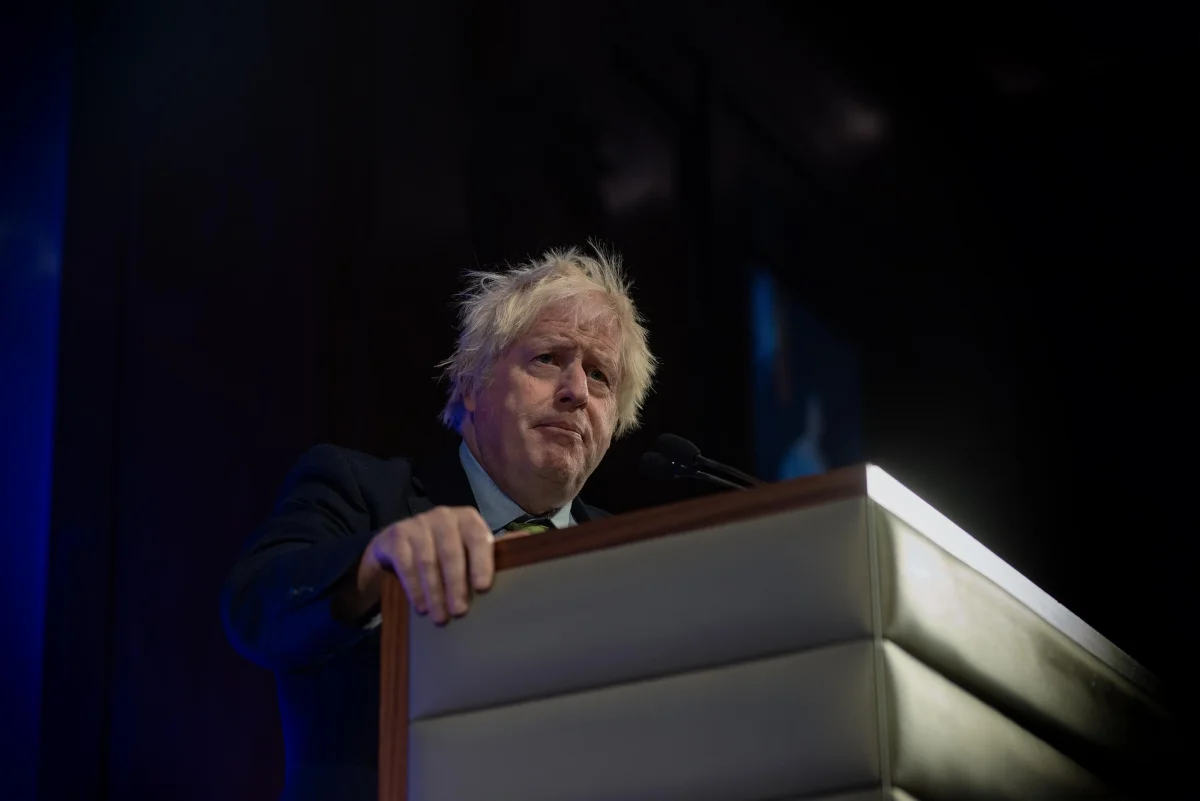
Host: Well, it's my privilege to start introducing our main keynote speaker for today — although I think, H.R., you would all agree, was an amazing keynote speaker.
But Boris Johnson holds a special place in the hearts of all Ukrainians. Because when — and I remember this, living in Kyiv at the time — when the American administration, let's say, was, I think, dismissive of Ukraine's chances of holding out, just like his hero, and the man he's written a book about, Winston Churchill, who was also my hero growing up, which my father taught me about when I was studying history as a young child — Boris was someone who saw with clarity the threat. And more importantly, he had the courage, when everything looked completely hopeless, to call out what it was, which was that Vladimir Putin's Russia is pure evil. And more importantly, to Ukrainians, he believed.
He sent lethal weapons. He sent visible signs of support, which the Americans, I don't think, were quite as willing to give. And for the Ukrainian veterans that are in our foundation, when we do the Ukraine Freedom Summit, it's important for us to bring people that have helped Ukraine fight and maintain its freedom. And I can't think of anyone who's more deserving of our award, which we'd like to present, which is the Freedom Fighter for Ukraine award.
So Boris Johnson's going to come up here. He's going to give a speech on why it's important to win in Ukraine. I'm going to let him, obviously, give us his perspective on how important this is. So as soon as he's ready, we're going to welcome Boris Johnson to the stage. Thank you very much.
Boris Johnson: Thank you. Thank you very, very much. Thank you so much. Good afternoon, everybody. Thank you. Very kind of you.
Well, look, thank you so much. It's a great, great pleasure to be at this Borderlands conference.
And I'm not normally one of the world's great haters. But I think it was yesterday I saw that, as part of his increasingly desperate and cynical attempts to terrify the population of Kyiv, the Russian president Vladimir Putin attacked yet another apartment block. I'm sure you all saw this — so that a young mother and her two-month-old baby were actually blown out of the building and killed by an Iranian-designed, Russian-made Shahed drone.
And perhaps my feelings were sharpened because — you may not believe it, but I actually have a baby of about that age myself. But I read this, I saw this, and I gave way to absolute hatred and contempt for what the Russian president is doing. Because it's not only criminal against all civilized norms — that's obvious — I also think it's completely pointless.
We know it's pointless, because the people of Kyiv will not be terrorized and intimidated, and they will not submit. They will never surrender, and Putin will never subdue Ukraine. And in almost three and a half years of all-out war since 2022, he still only captured less than 20% of Ukrainian territory, at a cost of a million Russian casualties.
And I think it has been calculated that if a common or garden snail had set out to cross Russia at the same time as Putin dispatched his 115 battalion tactical groups in February 2022, the snail would now be in Poland. So Putin is not only morally inferior, he's actually slower than the average slug.
And his forces have been repulsed again and again around Pokrovsk. It's still very difficult, but the Russians have still not broken through. And Putin's vaunted summer offensive has fizzled, as some of us thought it would. His economy is stuttering, inflation and unemployment rising, and the Ukrainians — the intrepid Ukrainians — are doing so much damage to his oil and gas sector that production of gasoline is, I think, down about 20% now. It was 10%, it's like 20%, with queues to fill up.
Look, I hope I'm not being too personal if I say that the man himself is actually starting to look notably frailer. You know, there's something a bit odd about his gait these days, the way he holds himself. And this isn't the bare-chested, bareback-riding Putin who used to go off chasing musk elk, or whatever they are, in microlights, and fooling around with snow leopards and so on. This is an aging leader who knows he has made a terrible mistake but cannot find the way out.
And it is therefore time to show him the way out, and to show what he, I think, subconsciously knows to be the truth: that he has lost. And indeed, he lost from the moment he decided to invade. We need to show him that truth, because otherwise he will just continue with what he is doing. Not necessarily because he thinks he's going to overwhelm Ukraine, but because he will continue for his own political survival, which is really, fundamentally, what he cares about — because he thinks that continuing the war is now the most politically expedient thing to do.
And he'll continue to blow babies out of apartment blocks and to inflict untold suffering on entirely, entirely innocent people — not just in Ukraine but in Russia too. And the war in Ukraine will continue to be one of the biggest global drags on peace and prosperity.
And so when it comes to getting that message through to Putin, I think we all know the reality. There's only one language that he understands. I mean, one set of arguments — what language you put it in, Russian or English or whatever — there's only one set of arguments he understands. It isn't flattery, by the way. You can't schmooze Putin. You won't change his calculations by red-carpet treatment or flypast, right? That's not going to cut the mustard.
And it's no use trying to compromise on territory, any more than you can compromise with a crocodile that has its jaws wrapped around your leg. Read what he says. Look at what he says. It's perfectly obvious. He means it. He believes that Ukraine is indivisibly part of the Russian motherland. He wants the whole of Ukraine.
And it's frankly insane to think there's some deal to be done by offering Putin the chance now to gain land in Donbas that he currently does not even occupy and has never occupied throughout the conflict. No Ukrainian leader could possibly agree to such terms — giving up the fortifications in the Donbas, abandoning land that thousands and thousands of Ukrainians have died to defend. It's not only insulting to the memory of their sacrifice — I'm sure that all Ukrainians here would agree that it is politically impossible — it's also strategic madness. Because in the longer term, that sacrifice of land, that sacrifice of those key defensive fortifications, would open Russia's way to Kyiv and the rest of the country.
There's only one way to get Putin to stop his cold-blooded murder, and that is for everyone — and I mean everyone in the West, everyone involved in this conversation — to stop the ghastly pretense of moral equivalence between Putin and Zelensky, between Russia and Ukraine. There is no shared responsibility for this war, because since 2014 there has been only one aggressor, and at the present time there is only one of the two parties that refuses to adopt an unconditional ceasefire — and that is, of course, Russia.
And therefore, the only way to get Putin to join Ukraine in agreeing to stop the bloodshed — which, by an objective, I totally support — but the only way to achieve that is through strength: through the collective economic, military and political strength of the West united. We can end this war. We can bring Putin to the table. It would be hard, but we can, if we do the following.
We need first to recognise that actually Donald Trump is right about secondary sanctions. Because India and China together are now taking about 85% of Russia's oil and gas exports. And not only should we in Britain, we in Europe, have the guts to follow America's lead — we should accept that here in Europe, and probably here in Britain, we are also already indirectly buying that sanctions-busting oil and gas, aren't we? Because it's a mysterious fact that India's exports of diesel to Europe have gone up 137% in the last year.
So I think we need to widen — I think we need to follow what Donald Trump has done. Add in the secondary sanctions to the other culprits, and we all know perfectly well who they are, and stop buying Russian stuff ourselves. And by the way, it's a fact that both the American and the British nuclear industry are still buying Russian uranium. Do you know that? I'm surprised — you didn't? You did? They are. It's absolutely ridiculous.
And then we need to eliminate the shadow fleet — the 500 or 600 tankers, vessels, some of them pretty old, that are helping Putin to ship his oil abroad. We should shine a light on them, board them, inspect them, take them out of the shadows. In fact, I think we should take them out altogether. If, after due warning and after the crew have been given the chance to abandon ship, a member of the shadow fleet should find its way to Davy Jones's locker — so much the better, frankly. These people are not only breaking international law, they're helping to fund a war machine. These shipping tycoons — and I'm afraid some of them are in Europe — are complicit in the murder of Ukrainian civilians. They are profiteering from carnage, and it's time they were made to pay a price.
Next — and very, very, very important, because we've talked about it for far too long — we should all pull our fingers out, particularly in Europe, and finally unfreeze the 250 billion or 300 billion dollars of Putin's frozen assets, most of them in Belgium, and obviously hand them over to Ukraine. And it's perfectly legal. Hand them over to Ukraine as an offset, as a down payment on the reparations that Russia will inevitably have to pay when this war is over. And if the Ukrainians use that cash to build or buy more weapons, so much the better. Because the best and fastest way to bring this war to an end is to make sure the heroic Ukrainians — I can actually see some representatives of the Ukrainian Armed Forces here in the audience, and I'm lost in admiration for what you've done — what those heroic Ukrainians need above all is the wherewithal to continue their fight.
And that is partly a question of giving them more Western weaponry. Because actually, after three and a half years of war, there are still some anomalies. Germany, after a slow start, has stepped up very, very impressively, and is now the single biggest donor — I think the single biggest European donor of aid to Ukraine, ahead of the UK now, by quite some way. But though we in the UK have given Storm Shadow, the French have given SCALP, the Germans have still not given Taurus missiles to Ukraine, I think for political reasons. I don't understand why not, and they should.
And then, as actually President Trump has argued himself, quite rightly, we need to give the Ukrainians the permission to fire those weapons at the bases that are being used to dispatch the missions to slaughter their civilians — even if those bases are in Russia. Of course we should. Why should the Russians be able to hit anywhere in Ukraine when we refuse to give Ukraine the permission to fire back? They still don't have all the permissions they need. Quite often missions are frustrated, and the delay is now unconscionable.
Above all — and perhaps even more important than allowing the Ukrainians to use our weapons or giving them more of our weapons — we need to do much more. And this is where the 250 billion really, really can come into its own. It's a huge slug of money; it can make a big, big difference now to the outcome of this war.
We need to help the Ukrainians to build up their own amazing defence capabilities. They need more first-person-view drones, more interceptor drones — some of them now built, as everybody knows, with the help of Eric Schmidt, formerly of Google — drones that can take out the Shaheds. And they need more long-range drones and missiles, as I have just described. With the right support, the right financial support — money is going to be hugely, hugely important — the Ukrainians could increase the manufacture of long-range missiles. They've got this new type called the Flamingo missiles, from 30 a month, I'm told, to 200 a month. That can make a huge difference.
And in short, these are some of the economic and military ways — I mean, there are other things we could do as well, but these are just some of them. These are the things I think we should most urgently be doing now to put pressure on Putin, really make him recognise the reality.
But there's also a political point. To get this war over, and to get the right result, we need to show the Kremlin what has been in doubt for so long, and what has really been the root of the problem. And that is the ambiguity about the long-term geostrategic destiny of Ukraine. We need to show, visibly, by what we do, that Ukraine is fated — they've chosen — to be part of the West, and we are going to help and encourage them in that vision.
And that's why the idea of the Coalition of the Willing — although it's, you know, frankly, the Coalition, well, it hasn't happened yet, has it? But that's why the idea of the Coalition of the Willing is so important. And my question to European leaders now — UK, everywhere — is: if immediate membership of NATO is off the table now — I very much regret that it is — but why don't we not only assemble the Coalition of the Willing, but also begin the deployment of that coalition? Not in a war-fighting capacity, because I doubt that that will be easy to get through any European legislature, let alone the House of Commons. And in any case, you'll never get a Western, a European peacekeeping mission that's half as effective as the Ukrainians themselves in protecting Ukraine. They're the heroes. They're the people who can do it.
The reason it's so attractive to me as an idea is that, by expanding what we've already been doing — you remember, through Operation Orbital, offering training, logistical support, and so on, backfilling — we could show collectively, as the West, as Europeans, Brits, France, Germany, everybody, all the Austrians, the whole Coalition of the Willing, that Putin does not decide which foreign countries, other than Russia, get to come to Ukraine and to help its defences. The Ukrainians decide who they're going to invite onto their soil.
And I think that that force, that Coalition of the Willing, could be visible proof right now that — the question that Putin needs answering in his own head — the answer to that question is that Ukraine is part of the Western security architecture. And that that's fundamentally where it's going. Because in the end, this is not about territory. This is about destiny. This is about identity. This is where Ukraine has chosen to go.
And we need to give — we need to incarnate that choice by our presence in Ukraine, ultimately with the Coalition of the Willing, with Western security guarantees, and make it physically, practically clear that Ukraine is on the path towards Western institutions — not just the EU, but one day NATO too.
And I think we need this show of strength — political, economic, military — now. Because that is the only way to get Putin. That's the only conceivable way to move Putin from his current calculation, which is that he can just rope-a-dope us. Get him away from that; get him to compromise and to agree to a ceasefire. Because frankly, that's what I think is in the best interests of the people of Ukraine right now.
I think the bloodshed has been terrible. And I don't know — you can't be more Ukrainian than the Ukrainians. If the Ukrainians want to fight on, that's their choice. But I think a ceasefire would be a good thing, even if sadly it means the freezing of the conflict along the current line of contact, so that Putin remains in de facto control of a big chunk of Ukraine. It wouldn't mean any compromise on sovereignty.
From Putin's point of view, it would offer him — with total command, as he has, of the instruments of propaganda and opinion in Moscow — it would offer him his way out. He could say that the objectives of the special military operation, whatever they were — to denazify the non-existent Nazis, or whatever — they've all been achieved. It's like the end of Raiders of the Lost Ark, or whatever. He could say that. The Russians would believe it.
The Ukrainians would know that they have effectively saved their country and saved their democracy — and, by their heroism and by their example, of course, saved other countries around the world from the threat of being attacked and being bullied, including, who knows, Taiwan.
Look, the Ukrainians have done it. They've achieved this, as everybody knows, over three and a half years, through amazing physical and moral courage and resilience. All we need now is for Ukraine's global supporters to show about one-tenth of the courage of the Ukrainians. And we can end this war in the only way I think that it can conceivably be ended, and that is with a free, sovereign, and independent Ukraine.
Thank you all very much for listening. And Slava Ukraini. Thank you.