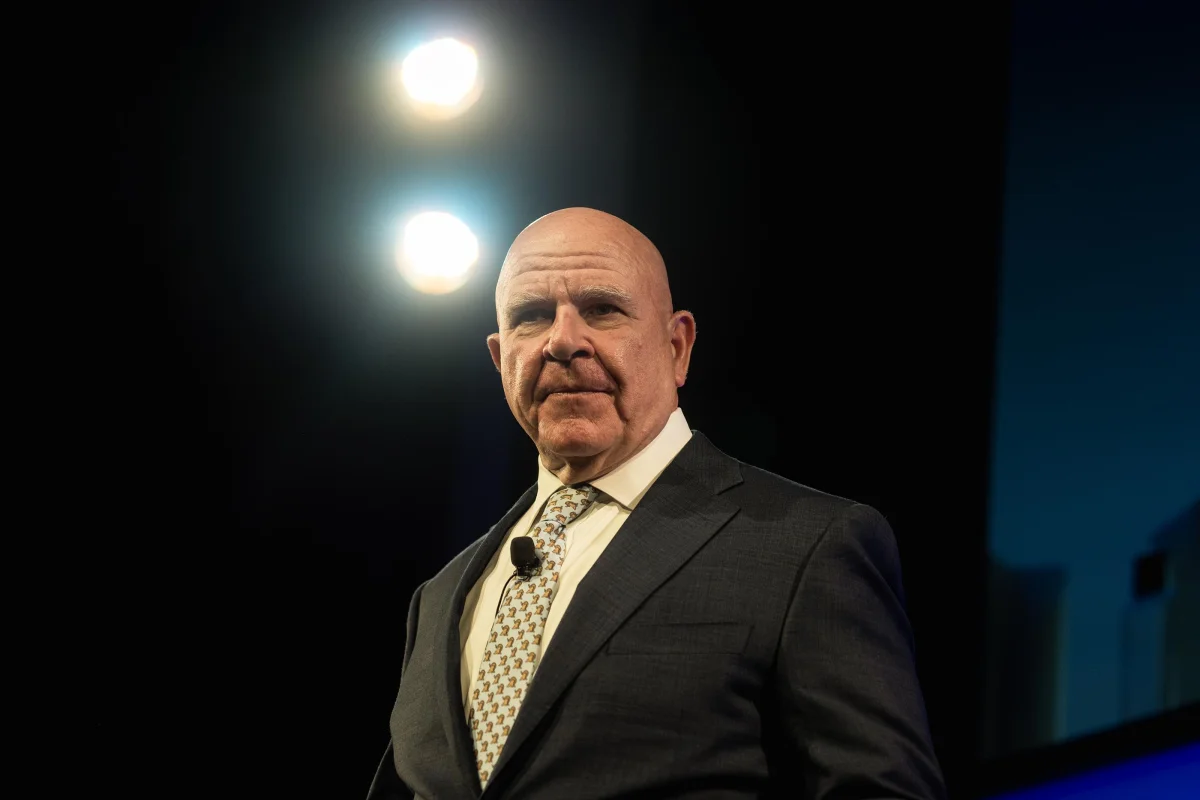
H.R. McMaster:
What a privilege it is to be with all of you, especially our Ukrainian heroes and veterans here. The topic is the future of war — what we're learning from the war in Ukraine.
I'm going to approach this topic with a great deal of humility, because we have veterans here. I'll try to be very quick and hear what's on your minds, what you'd like to add to the conversation, or maybe correct or amplify any of the points that I make here.
I've organized a few observations at the different levels of war — some strategic observations, then operational, technological, and tactical — and then a discussion of continuity and change. I'll try to do this, as I mentioned, pretty quickly.
The strategic level
At the strategic level, I think we have to acknowledge that what we're coping with today — what Ukraine's coping with today — is not just the aggression of Russia. It's the aggression of an axis of aggressors, which includes two revanchist or revisionist powers on the Eurasian landmass, Russia and China, as well as North Korea and Iran.
There has been this idea for a long time that what we have to do is prevent this war from escalating. And what we have done is talked ourselves, I think, out of confronting this axis in a way that would allow us to weaken it. There are many people, I think, who are under the delusion still today that this axis can be persuaded to break apart — that you can divide especially China and Russia — when I think instead the opportunity has been, and remains, the opportunity to glue them together, to tape them together, because all of them have overextended themselves based on a perception of weakness. Weakness in the West in particular, especially the United States and Europe.
And what I mean by that perception of weakness really goes back to the unenforced red line in Syria in 2013, which I think was a precursor to the first invasion of Ukraine in 2014, and the disastrous self-defeat and humiliating withdrawal in Afghanistan. I think you can draw a direct line between that and the February 2022 massive reinvasion of Ukraine. So I think we have to recognize that this axis of aggressors is provoked by weakness, and we have to portray strength against that entire axis.
I don't need to go through all of the statistics in terms of how much support China is providing by feeding Putin's ATM — by giving him the electronics and the hardware necessary to sustain his onslaught against Ukraine — or to talk about North Korea. We have North Korean troops fighting on European soil, maybe at least 6,000, maybe up to 30,000 more coming. And of course North Korea providing about ten million, I think the number is, rounds of artillery, and Iran providing Shahed drones and so forth.
So I think the first strategic lesson is that we really should be taking on the entire axis of aggressors, because they're working in concert with one another. They have different objectives, maybe, but what they share is an objective of tearing down the existing rules of international discourse and replacing them with a new set of rules that are sympathetic to their authoritarian forms of government — and in China's case, its statist mercantilist economic model. All we have to do is listen to the language of the Shanghai Cooperation Organization meeting in Beijing, and the celebrations at the end of World War II that were an effort to warp history in favor of China's interpretation of history.
The second huge observation we can make at the strategic level is the importance of strategic depth. There's going to be a panel on that, so I'll just quickly talk about aspects of it. Depth has to do with our defense industry — our capacity to generate the weapons and the ammunition at scale that's necessary — but also depth in all of our armed forces. What the Ukrainian Armed Forces have shown us is that you need a whole range of capabilities, but you also need the capacity, the depth in your force, to be able to sustain operations over a longer period of time. That panel, I think, will talk more about that observation at the strategic level.
But depth is also geographic depth, and depth across domains. It's not quite as obvious, but this war is playing out in space as well, because it's the combination of surveillance and intelligence collection capabilities — including drones, which I'm sure we've been talking about quite a bit, but also low-Earth-orbit satellites, for example — and now the ability to absorb so much data, and just dramatically increase the transparency of the battlefield. So future war, which is the topic of this short talk, is going to space. And that trend will continue. I think it could be quite dramatic if there's another war — maybe even as this war continues — that much more of the activity will be carried out in the space domain.
And then, of course, you don't have to say this to our Ukrainian brothers and sisters, but wars will affect your homeland. This is a direct onslaught on Ukraine. But you see, by the broader shadow war that Russia has been waging against Europe, that Russia is already waging a war against the homelands of European countries as well — cutting undersea cables, blowing up warehouses, putting out assassination contracts, and of course the various forms of cognitive warfare that Russia has been perfecting over many years. The United States is subjected to this as well. And Russia and China, I think, will continue to work together in this area, in the cyber domain, for example — going after vulnerable infrastructure, the various Volt Typhoon attacks that have been uncovered in the United States.
So this is the trend, and we have to consider that future war will be affected by a broader coalition of this axis of aggressors. We need depth, the war will be carried out in depth, and it will affect our homeland as well. And then the third point, which we've seen, is that war will go beyond conventional means and incorporate this kind of shadow war — cognitive warfare, war against our own societies in many different ways, infrastructure, but also the cognitive war that is meant to diminish our will.
The operational level
At the operational level, what we're learning from our Ukrainian brothers and sisters is the importance of doing everything we can to build capabilities into our force, to restore mobility to the battlefield. When I look at what's happened in Ukraine, oftentimes I think it really mirrors, to some extent, the Western Front in World War I — when you had the situation where, with the advent of the machine gun initially and then massive artillery, the offensive was no longer viable.
What happened under those conditions — what the Germans called, in the 1916 period, Materialschlacht, with massive artillery — their solution was the elastic defense. Because troops who were forward, much like today, are vulnerable to FPV drones and other capabilities, they had to create greater depth in the battlefield, thin out the front lines with just machine gun outposts and so forth. And then, to restore mobility on the battlefield in the 1917 into 1918 period, especially during the Ludendorff Offensives, the idea was to use infiltration tactics, or Hutier tactics — very small teams that could infiltrate, get behind the front lines, attack in depth. And this is, I think, what we've seen Russia try to do with these offensives and so forth. So I see a lot of analogies between these adaptations and World War I.
But of course, it wasn't until the advent of mobile protected firepower — in the tank — that mobility was really restored to the battlefield. And we saw that obviously with the attacks in 1940, for example. So the technologies will be much different to restore mobility to the battlefield, but I think at the operational level we need a whole range of capabilities to do that. And of course, as I mentioned with these observations at the strategic level, we have seen the battlefield in depth become very transparent — because of drone capabilities, because of low-Earth-orbit capabilities, but also the whole range of big-data analytical and AI-related capabilities to make sense of all that data and create a high degree of transparency.
So at the operational level, to restore mobility, the second key observation is that we have to develop a whole range of capabilities to blind our enemies and deceive our enemies. I won't go into any details about that, but I think there are specific things we could talk about, or that future panels here could take on.
And the third observation is that warfare is going to continue to be conducted across multiple domains — air, sea, land, space, cyberspace. The Ukrainians have shown that to us with tremendous innovation, especially in the maritime domain. Among many other areas, in the maritime domain, without a navy, they have been able to develop capabilities that have driven off the Black Sea Fleet and inflicted very severe damage on that fleet. So again, operationally: what it will take to restore mobility, what it will take to deal with this transparency on the battlefield and blind adversaries, and then what capabilities we can develop to ensure that we can operate across all those domains and combine capabilities across domains — to seize and retain the initiative, to essentially regain the initiative at the operational level.
Technology and its effect
On technology and its effect — this is a statement of the obvious — autonomy and drones in particular, combined with artificial intelligence, is really going to bring us to a new frontier of how we can employ these capabilities. Because at the moment, in many cases — and this is already evolving and changing — you have one person controlling one drone, especially those that are designed to avoid electromagnetic warfare. What's going to happen is it's going to go from one person controlling one, to one person controlling many. And that's going to be because of the ability to put computing power at the edge, to have self-healing mesh communications capabilities, and — because you have computing power at the edge — the ability for machine learning and adaptation at the edge, such that autonomous systems can be given missions, for example, rather than being mainly a loitering munition, a means of applying firepower, or a way of targeting particular enemy capabilities. So on technology, this evolution in autonomy — going from the one to the many — is, I think, what's really critical.
The second is more an observation on how important it is to have continuous communication between the masters of fighting, like those who are here today, and the designers — and to shorten the innovation cycle. What Ukraine has done, I think, is just astounding to me, in terms of how quickly capabilities can evolve based on that work. [I'm under attack here by some form of — I hope it's not a drone.] But the ability to innovate so quickly, and to be so competitive in that cycle of innovation to stay ahead of the enemy —
But finally, on technology, as we think about future war, we have to think about the continuous interaction of opposites — of certain capabilities, offensive and defensive capabilities, drone and counter-drone capabilities. And we have to remember there has never been one single decisive capability in war, right? We had the submarine and the sonar, the bomber and the radar, the machine gun, the tank, the anti-tank missile. And so as we develop defensive capabilities, counter-drone capabilities, we have to recognize that continuous interaction. There are some who want to make a linear projection based on the technologies that we're observing being employed in Ukraine. But we have to recognize there will always be countermeasures, and we want to be ahead on anticipating those countermeasures, developing them ourselves, and combining them with new and evolving capabilities to maintain our competitive advantage from a technological perspective.
The tactical level
At the tactical level, as I mentioned, from a defensive perspective, I see a kind of continuity with the elastic defense and depth. But I think also, though some people want to think that this is forever changing the kind of tactics, I also see the predominant focus on the importance of close-combat overmatch as well. So I think we want to keep that in mind: we need to have these longer-range capabilities, we have to adapt to defend ourselves from them, but at the same time maintain overmatch in close combat.
There are some people, I think, who are looking at the experience in Ukraine and thinking that what we need exclusively are longer-range capabilities. But what you also see from Ukraine is that it's really the control of territory, populations, and resources that is vitally important today, and will be vitally important in future war as well. And so you need units who are capable of close-combat overmatch, and who have not just the range of technological capabilities but the stamina, the courage, the cohesion, and so forth to be able to fight and win in close combat.
The second observation — there are three observations in each of these areas — is the vital importance of logistics. From what I'm learning from the experiences, trying to stay as closely connected to it as possible, is the tremendous struggle of sustaining combat forces at the front line when an enemy has these longer-range systems and there's this transparency on the battlefield. So I think at the tactical level, we need to put logistics up front in the evolution of doctrine, and in how we're going to integrate new capabilities, so that we can sustain ourselves effectively, and do that over a long range and contested. So: the elastic defense is important, close-combat overmatch, and logistics.
Continuities in the nature of war
And then, finally, what I'd like to talk to you about is that, as we think about future war, what we are biased toward most often is understanding the changes — changes in the character of warfare. Of course we're seeing that dramatically in Ukraine, and all of you veterans here have experienced it. But I think we also have to remain cognizant of continuities in the nature of war. There's an American historian, Carl Becker, who said that memory of the past and anticipation of the future should walk hand in hand in a happy way. And I think when we get into trouble a lot of the time is when we neglect continuities.
For example, I think there are four continuities, the way I think about it — and all of these apply to some of the most significant aspects of the war in Ukraine, in my mind.
The first is that war is an extension of politics. Everybody knows that, right? Clausewitz would have said that. What that means is that we have to conduct military operations in a way that contributes to a sustainable political outcome. There are some people who want to divorce what they would like to see as a political outcome from what has to happen militarily. And I see this with this drive to say we want a ceasefire, we want peace. But what we can't neglect is that winning still entails convincing your enemy that your enemy's been defeated. And for one, I don't believe that Vladimir Putin will stop until he is stopped, and he won't be stopped until he concludes that he's losing the war, or that he can't continue the war, at least at an acceptable cost.
The second continuity is that war is human. People fight for the same reasons that Thucydides identified 2,500 years ago: fear, honor, and interest. Oftentimes, when we look at an effort to try to end a war, we mirror-image the other. We don't think about what are the emotions and the ideology that drive and constrain the other. And I think this has been an element of the discourse around the prospects for peace in Ukraine as well. If we want the best shot at peace, we have to recognize that human dimension of war.
And of course, as the warriors here know, at the tactical level that human dimension of war has everything to do with unit cohesion, and your unit's ability to continue to fight under the most difficult conditions of combat. That comes from the qualitative aspects of preparing for combat, and particularly from developing confidence — unit confidence in their ability to fight together as a team — but also the bonds of trust that build up when you train and build a high degree of cohesion, or when you fight together for a period of time. And of course, the ethos that you develop in our armed forces, especially the ethos that revolves around certain principles we're committed to — our sense of honor, that we're more afraid of letting fellow soldiers down than we are of any enemy bullet, and our willingness to sacrifice for each other and the mission.
As I see the sustained combat that the Ukrainian Armed Forces have been in, I think it just highlights to me the courage and the valor of Ukrainian soldiers — but also the need to make sure that units at times get a break, that they can train together, and that there's an opportunity to generate unit replacements that can come into the fight after developing that degree of cohesion and confidence. So I have great admiration for the Ukrainian Armed Forces, because I'm very cognizant of this human dimension of war that people often neglect. And I think this is Ukraine's greatest competitive advantage — because their soldiers are so well motivated to protect their families, to protect their homeland. And the Russian aggressors, many of them are pressed into service and are motivated more by, maybe, an SVR person behind them with a pistol to their head.
The third continuity is that war is uncertain. I think we've seen in the war in Ukraine these predictions of linear progress. And there's never really linear progress in war, because of the continuous interaction — and because of the brilliance of Ukraine. When people were saying Ukraine doesn't have the assets it needs to continue to challenge Russia, then you see an operation like Operation Spider's Web. Or you hear that Russia is really strong — this is one of Putin's ruses, right? One of his elements of deception is to portray Russia as very strong. And as you see, the massive losses that they've taken, the effect on their economy, and most recently the strikes against Russian oil refineries — which I think is having a very significant effect and is a brilliantly conceived priority to go after.
And then finally, as we all know, war is a contest of wills. And it's so important for us to understand that continuity. I think that what happened with us in Afghanistan — the United States, UK, and our other allies — it was self-defeat. I think we talked ourselves into defeat. And I think what is most important for leaders in countries that are at war is to explain to their populations continuously and effectively really two things: What is at stake? — that's pretty apparent to Ukrainians; it's their survival. And second: what is a strategy that will achieve a favorable outcome at acceptable cost and risk? I know there's going to be a panel later today that's going to talk about that as well.
So what I'd like to do is end there, and just see what's on your mind. We're talking about this broad topic, the future of war. I've offered some observations at the strategic, operational, tactical, and technological levels, and some enduring continuities. But there's a heck of a lot of expertise and experience here, and I'd love to just hear what's on your mind. So ask a question if you like; but if you'd like to just make an observation, I'd be happy to hear it and learn from your perspective. So, over to you.
I can't really see — can you see it? Because I'm afraid the light might be blaring off my head at you. Okay, all right. Oh, you were calling people? Perfect. Thanks.
Questions & Answers
Tobias Ellwood (former UK Defence Minister): Thank you. Hi, Tobias Ellwood, former defence minister from the UK. We've met in the past. Great to hear you speak again, and I think everybody would concur with what you say.
The elephant in the room seems to be that America and Europe are not on the same page. We've had that devastating attack on Ukraine only a few days ago. And I can't help imagining that across capital cities in Europe, everybody's asking themselves: what level of audacity must Putin stoop to before America — before Trump realizes that Putin isn't somebody we can do business with, that Russia can't be trusted, and that we shouldn't be doing a deal with Moscow?
So my question to you, sir, with all your experience — and I think, as I say, we all agree — is that until America and Europe are on the same page, then any talk of a ceasefire is simply playing into Putin's hands. You touched on the Shanghai Cooperation Organisation. Putin rubbing shoulders with China, with Xi, should give a firm indication as to where his loyalties lie, where he wants to actually go. And that is the bigger geopolitical challenge, which I'm not sure even in Britain we're coming to terms with — where our world order is going. So, how do you persuade your former boss to come to the table on the European side and not court Putin? Thank you.
H.R. McMaster: Thank you. Thanks for your amazing leadership over so many years. Let me just offer a few thoughts on this.
First of all, I think you have to be able to counter Vladimir Putin's deception and influence campaigns. The way Putin does this with many Western leaders — he tailors it to the leader, because the SVR and GRU study these leaders and try to understand how they can manipulate them as best they can. And Putin has a great track record, from Chancellor Merkel to really all US presidents, I would say. He has kind of a four-step process that he goes through, that you have to counter.
The first of these is that Putin will first flatter the leader and try to ingratiate himself. You've seen this with President Trump and many others as well — the portrait that he had done for him, telling him he went to pray for him after the assassination attempt against President Trump, and so forth. He makes many public statements that are meant to flatter that leader.
The second thing he'll do is try to create a sense that he is aggrieved, and try to create a sense that there's some kind of mutual aggrievement there — because of NATO enlargement, that there've been so many offenses against him, the idea that he's fighting against Nazis in Ukraine, that he's somehow aggrieved.
The third thing he'll do is hold out the prospect for some really big deal, or something great that could be done together. In this case, all these efforts to try to talk about issues other than Ukraine: wouldn't it be great if we could reduce nuclear weapons? Wouldn't it be great if we could fill in the blank?
And the fourth thing he does is portray any other alternative as weak, or his competitors as weak — like he's trying to do with President Zelensky. Portray himself as strong, the other as weak. So you have to counter that.
But I think the two main arguments for Americans that are really important at this stage are, first of all, that the war in Ukraine is connected to this axis of aggressors, to the broader competition with China, Russia, North Korea, and Iran. And the second is the observation that unless the Russian threat can be dealt with abroad, it can only be dealt with at an exorbitant cost once it reaches our shores.
A lot of Americans — and this is what President Trump channels sometimes — feel like they have a lot of work to do at home. We have a lot to do in the United States. And so, why don't we just focus on ourselves? What they don't realize is the degree to which Ukraine has been fighting a war for all of us, on this frontier between civilization and this barbarous alliance between Russia, China, North Korea, and Iran.
But it's a great question. It's the argument I've been trying to make in The Economist and other places. I think all of us need to continue to help our citizens understand how the war in Ukraine is intrinsically important for Ukrainians, for humanity and for humanitarian reasons, but also how it's important directly to the interests of those citizens as well.
Host: If I can just interject very briefly and make sure that everyone for the next panel, alongside H.R., is all miked up — that would be wonderful. There are a couple of people I'm able to get their mics on ahead of the next discussion. We'll take one more question, and then there will be further questions after the next panel discussion, which of course H.R. will be part of as well. So, yes, one more please.
Alessandra Franzi (student, London School of Economics): Hi, my name is Alessandra Franzi. I'm a student at the London School of Economics, on Diplomacy and International Relations, and I'm in charge of foreign affairs for a small party in Italy, the Liberal Democrats, and I ran for the European election — just to give you a picture.
I wanted to ask you about, after Anchorage and the meeting there, the bombing of Kyiv, and then the [unclear] meeting in Shanghai — it's a pretty clear sign of how things are. So my question is: in addition to the support — financial support, and cooperation for the army and weapons and the war — what is the role you think diplomacy should play as well, especially in the middle and long term, as we all leave this planet? So at some point we need to use diplomacy. And the role of women in war, as well, and in diplomacy as well.
H.R. McMaster: Okay. So I would just say that what's really important about Anchorage was that Putin didn't get what he wanted. What Putin wanted in Anchorage was for the United States to approve conditions for a ceasefire that were unacceptable to Ukraine, and then to use that gap to drive a wedge between the United States and Ukraine, and the United States and Europe. I think, thankfully, President Trump didn't buy Putin's efforts there — and then I think European leaders had a very major role in that. So if you think of diplomacy as being conducted by heads of state as well as diplomats, I think the diplomatic effort by European leaders was very effective before Anchorage and after Anchorage.
Now, what is the role for diplomacy now? I think what's really important is that diplomacy cannot be effective unless there is a commensurate military effort to achieve the outcome you want to achieve. In recent years we've come into this habit of divorcing what we're doing militarily — and maybe from an economic perspective, a sanctions perspective — from what we want to achieve politically. A great example of the United States doing this is announcing our withdrawal timeline for Afghanistan while at the same time engaging in this dialogue with the Taliban political commission in Doha, and having this delusion that we could achieve a favorable diplomatic outcome without doing what was necessary militarily.
Secretary of State George Shultz used to be at the Hoover Institution, where I am, until he passed away at the age of 100. He said that negotiation is a euphemism for capitulation unless the shadow of power is cast across the bargaining table.
So to answer your question, what's necessary to get to diplomatic progress would be really two things. One is sustained support for Ukraine, which we're on a path toward, with Europeans providing the financial aspects of the support for their weapons and U.S. weapons. I would like to see added to that a long-term, low-interest loan to Ukraine to purchase other weapons that they want — or whatever they want to do with that loan — similar to the loan to Finland in 1919 to protect itself against the nascent Soviet Union, a loan that was paid back in full, by the way, to the United States. So sustained support for Ukraine would be step A.
Step B, I think, is maximum pressure not only on Russia but on the axis of aggressors who are aiding and abetting them. And all of them are in a position of profound weakness economically at this moment — China and Russia both. So, to answer your question: don't divorce diplomatic efforts from what you're doing from a military and economic perspective. It's a recipe for disaster. And then the second would be sustained support for Ukraine and maximum pressure on Russia.
Host: Just one final brief one, please.
Audience member (from Ukraine): Thank you, Pete. Thank you, [unclear], for taking your time, H.R. First of all, we are very honored to see you here and to have you here, so thank you for this.
Just in the development of your recent answer — and this is genuine, I'm from Ukraine and I'm interested in this, I might have a limited view from my country at war — so, on a scale of, let's imagine, five more sanctions on Putin at one end of the scale, to the other end — let's say, I don't know, bomb the Kremlin, and whatever — what do you think the leverage is that the free world has on the aggressor, on Putin and Russia? Because I think the sanctions are not effective, and it's obvious that we'll see no boost on the ground yet. Thank you.
H.R. McMaster: Well, there are seized Russian assets that could be put to use for Ukraine. I would say that would be step A — the European seized assets and the U.S. seized assets.
The second thing I would say — and there's an essay on this, gosh, I'm trying to think, by Marshall Billingslea, on what we could do right now; it's like ten sanctions, and I would just refer you to that. Maybe we can find it and pass it out. I would say that there is a lot that can be done based on the frailties in the Russian economy at the moment. We know that the economy is stagnant. He can't grow the economy — he never diversified the economy — he's sitting on piles of cash that he can't convert. Financial pressure still has a big role here, especially if there are secondary sanctions on banks that are facilitating a whole list of transactions — Chinese banks, for example.
And then I think working on this problem from the outside in — from the shadow fleet perspective, the secondary sanctions, or, as President Trump likes better, tariffs on countries that are purchasing Russian oil beyond what's permitted, and so forth. We saw this with India — I think maybe not a great move geostrategically, but along those lines. So I think there's quite a bit that can be done. I'm not an expert in this area, but the essay by Marshall Billingslea, I think, was very effective; it seemed to identify effective measures, and I think all of those should be taken immediately.
I don't think this incremental approach is working, because, as you're alluding to, Russia has become very adept at adapting to these sanctions. And we know — and there's been a lot of reporting on this in just the last several days — of the degree to which the group of dictators who got together in Tianjin and in Beijing are working on ways that they can circumvent these kinds of financial and economic sanctions.
Host: Fantastic. Thank you so much. H.R., I hope you've still got some ammunition in the tank, because I think you're going to stay with us.
H.R. McMaster: I just flew in this morning, so if I'm not super lucid, you know — that might be why.
Host: Fantastic. You did a wonderful job. Thanks.